Recent Broward Law Blog Features

Showing posts with label US District Courts. Show all posts

Saturday, April 11, 2009

Prosecutors Pay the Piper for Professional Misconduct in Miami Trial of Pill Doctor


Calling the actions of prosecutors "profoundly disturbing," a federal judge in Miami has ordered the U.S. government to pay sanctions topping $600,000 in the case of a South Florida physician charged with illegally prescribing painkillers.

U.S. District Judge Alan Gold is forcing the government to pay Dr. Ali Shaygan more than half the costs he incurred to defend himself at trial as punishment for secretly recording his defense team.

In a harshly-worded 50-page order, Gold said the "win-at-any-cost behavior" of federal prosecutors Sean Cronin and Andrea Hoffman raised "troubling issues about the integrity of those who wield enormous power over the people they prosecute."

Here is the story from the Herald:

Here is an anecdote for you. Bob Norman of New Times blogs that Gold is a 'knucklehead' for doing this. Ironically, if he were a lawyer, the Florida Bar would use a knuckle on his head for saying that. But we disagree anyway. Sure, the money is coming out of taxpayer's pockets. That is just one of the messages you have to send to the government for abusing their office. It is only a start though.

One of the things you have to ask yourself if you have been doing this a while is how many times has this gone on, unheeded, unchecked, undiscovered? Does anyone out there think this is the first time this has happened? How many people are in jail after convictions and serving time where if misconduct had been exposed, they might not be there?

I don't think you can start a new 'Innocence Project' for Brady violations (for discovery). But we can ask supervisors to initiate a review process; ask judges to ask their law clerks to scrutinize recent similar motions in comparable cases. May turn up something today that will free someone tomorrow.

Saturday, April 4, 2009

Verdict in Explosives Case Makes Me Think of Pot Laws


An Egyptian student was found not guilty on charges of carrying explosives that prosecutors said could have been used to build a dangerous rocket.

Prosecutors said deputies found PVC pipes, fuses and other materials that could have been combined with gasoline to build a destructive device when the former University of South Florida student, Youssef Samir Megahed, and a friend were pulled over on a South Carolina highway in 2007.

The lawyer for Mr. Megahed argued that the items were no more harmful than a road flare and that his friend, Ahmed Mohamed, put the items in the car trunk without Mr. Megahed’s knowledge. They were doing sparklers for a July 4th fireworks show, I suppose. But I digress.

The case, filled with terrorist overtones, came nearly four months after Mr. Mohamed was sentenced to 15 years in prison for making a YouTube video showing would-be terrorists how to turn a remote-control toy into a bomb detonator.

Here is a guy who had nothing to lose going to trial. But you gotta wonder how a guy gets 15 years under federal law for making a video showing how to turn a remote control into a bomb but gets thirty for growing too much weed in his backyard.

Friday, April 3, 2009

Federal Judgeship Appointment Lining Up for President Obama in Miami/Fort Lauderdale


A federal judgeship is opening in Florida, according to a story earlier this week by John Pacenti in the DBR

" Even before a call for official applications, some prominent names are swirling in the Miami legal community to replace U.S. District Judge Daniel T.K. Hurley, who took senior status.  Federal Public Defender Kathleen Williams and Miami-Dade Circuit Judge Robert Scola are expected to apply. But the seat is for Fort Lauderdale..

Sources say three other Miami-Dade judges — Kevin Emas, Mary Barzee Flores and Darrin Gayles — also plan to throw their hats into the ring.  Flores spent more than a decade as an assistant public defender before taking the bench in 2003. Emas was on the short list for the Florida Supreme Court twice last year. 

Attorneys Michael Hanzman, a name partner with Hanzman Gilbert in Coral Gables, and Judith Korchin, a Holland & Knight partner in Miami, also are expected to be in the mix when the Federal Judicial Nominating Commission seeks applications. A notice is expected any day. 

So far, the lawyers who are said to be interested in applying are exclusively from the Miami area even though Hurley sits in West Palm Beach. The Southern District has recommended to the administrative office of the 11th U.S. Circuit that the new judge be assigned to Fort Lauderdale, according to the office of Chief U.S. District Judge Federico Moreno.

Tuesday, March 31, 2009

Teen Girls Win 'Sexting' Case


Good news for social justice for kids.

A U.S. judge on Monday barred a Pennsylvania prosecutor from filing child pornography charges against three teenage girls caught with sexually suggestive pictures of themselves on their cell phones.

U.S. District Judge James Munley said he was issuing a restraining order on Wyoming County District Attorney George Skumanick because his proposed action would violate freedom of speech and parental rights.

The ruling came after the American Civil Liberties Union sued Skumanick on behalf of the girls and their families.

"The court agrees with the plaintiffs that the public interest would be served by issuing a TRO (temporary restraining order) in this matter as the public interest is on the side of protecting constitutional rights," the judge said.

The case has attracted national attention and revolves around the growing practice among teens of "sexting," a play on the term texting, in which nude or semi-nude photos are sent on cell phones or posted on the Internet.

The pictures, found last fall by officials of Pennsylvania's Tunkhannock School District, showed two of the girls wearing bras, and another standing topless with a wrapped towel around her waist. No sexual activity was displayed.

Last month Skumanick told the girls and 17 other students that he would charge them with possessing or distributing child pornography, which is a felony, unless they agreed to probation and participated in a "re-education" program.

All but three agreed to his demands, setting the stage for the lawsuit. Most civil libertarans were outraged. People like me blogged obsessively about it. Someone heard us all. Justice kicks in.
A related link from a previous blot...well it could have been called blot....but someone decided blog was better..

Monday, March 23, 2009

On Gideon's Anniversary, Court Appointed Federal Lawyers Get a Raise


Let's begin Monday by acknowledging a few intriguing notes.


Friday, I believe, was the 46th anniversary of Gideon v. Wainwright, the Supreme Court's 1963 decision holding that states have a constitutional obligation to provide court-appointed lawyers for indigent criminal defendants. Charged with breaking and entering into a Panama City, Florida, pool hall, Clarence Earl Gideon Gideon, was denied his request that an attorney be appointed to represent him. The Supreme Court reversed his conviction, holding that defense counsel is "fundamental and essential" to a fair trial.


"In our adversary system of criminal justice, any person haled into court, who is too poor to hire a lawyer, cannot be assured a fair trial unless counsel is provided for him," Justice Hugo L. Black wrote for the court. "This seems to us to be an obvious truth."


Gideon spawned systems for court appointment of criminal defense lawyers in every state and in the federal courts. But those systems are not without problems. At the state level, ensuring adequate funding is an ongoing battle. And for the lawyers who take court-appointed cases, ensuring adequate compensation is a whole other battle. Hourly rates paid to court-appointed lawyers remain well below private-market rates.

That said, private lawyers who take court-appointed cases in the federal system just got a pay raise. Last week, James C. Duff, director of the Administrative Office of the United States Courts, issued a memorandum directing the federal courts to increase the hourly rates and case maximums.


As of March 11, blogger Robert Ambrogi reports, the hourly rate for non-capital cases went from $100 to $110. For capital cases, the hourly rate went from $170 to $175. The maximum that a lawyer can bill for a case went from $7,800 for a felony trial to $8,600 and from $2,200 for a misdemeanor trial to $2,400. The maximum for a felony appeal is now $6,100, up from $5,600, and for a misdemeanor appeal $6,100, up from $5,600. The federal Office of Defender Services has detailed information about the new rates and maximums.

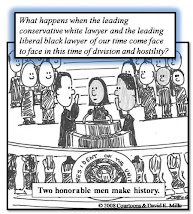
Here's the case that made history:

Monday, March 16, 2009

Madoff Wants Out of Jail Before Sentencing and Editorial Cartoon of the Day


Off the Wall Street Journal Blog by Ashley Jones, who just replaced Dan Slater.


First, as anticipated, Bernie Madoff, who pleaded guilty on Thursday to 11 charges related to his operation of a $65 billion Ponzi scheme, has appealed Judge Denny Chin’s decision Thursday to revoke his bail. Click here for the WSJ story; here for the filing. A hearing in front of a three-judge panel of the Second Circuit is scheduled for Thursday. Madoff is currently being held in the Metropolitan Correctional Center in lower Manhattan.


Madoff’s lawyers argued in the filing that their client isn’t a flight risk, noting his assets have been frozen, that he has previously complied with his bail conditions and that he “dutifully appeared” in court to plead guilty despite knowing he faced a lengthy prison term.


“The district court’s conclusion that Mr. Madoff is a flight risk is clearly erroneous,” Horwitz and Sorkin said. “The risk of Mr. Madoff’s flight in this case is virtually zero because the lower court’s previous bail orders set stringent safeguards to ensure that Mr. Madoff is both sufficiently dissuaded from fleeing and is closely monitored while detained in his home.”


Prior to a conviction at trial or a guilty plea, the burden is on prosecutors to show a defendant isn’t eligible for bail — namely he’s a risk of flight or a danger to the community.


The burden shifts to the defendant after a conviction, said Bradley Simon, a white-collar defense lawyer at Simon & Partners in New York and a former federal prosecutor. “I just don’t see any basis for the Second Circuit to reverse the judge,” Simon said.


In other Madoff news, we also now know that Madoff says he held in assets just weeks after his multi-million fraud was revealed: between $823 million and $826 million. This was revealed in a document filed alongside his bail motion.


The bulk of the assets came in the $700 million he valued for the ownership of his business, which is now being liquidated in a bankruptcy proceeding. The rest is a list of various Robb Report possessions: a mansion in Palm Beach, Fla., estimated at $11 million, half-interest in a BLM Air Charter aircraft worth $12 million, and a Steinway piano valued at $39,000.

Thursday, March 12, 2009

Blagojevich Fails to get Prosecutors Off His Case


A federal judge has turned down a request from impeached former Illinois Gov. Rod Blagojevich to have Chicago's top federal prosecutor and his staff thrown off the corruption case against him.

Chief Judge James F. Holderman of U.S. District Court said in an order issued last Friday that "no legal precedent supports the granting of the relief sought by the defendant Blagojevich in this motion." Apparently a prosecutor calling a defendant a lot of names is not as bad as a lawyer calling a judge a few names. Feel me, Sean?

Blagojevich had argued that removing U.S. Attorney Patrick J. Fitzgerald from the case was necessary because the prosecutor made inflammatory remarks about him at a news conference after the then-governor was arrested Dec. 9. Inflammatory is mild. What Fitzgerald said was that Blagojevich had been on "a white-collar crime spree" that would make Abraham Lincoln "roll over in his grave."

When you heard some of the Blagojevich tapes though, you understand Fitz's reaction. But Gerry Spence did a blog piece which I posted when I first inaugurated the blog and I think it is worth looking at again if you never caught it before. Our readership has gone up exponentially in the first two months and many of the earlier pieces I posted many of our new readers have never seen. So here it is again:
http://browardlawblog.blogspot.com/2009/01/guilty-until-proven-innocent.html


Interestingly, the Judge did not totally shut the door on Blagojevich making the same argument again before another jurist. "If an indictment is returned charging defendant Blagojevich with federal, criminal offenses, the district judge to whom the case will be assigned pursuant to the clerk's office random assignment system, will be the appropriate judicial officer to address the matter if raised at that time by the defendant," Holderman wrote. The jurist set an April 7 deadline for the government to obtain an indictment from a grand jury.


Meanwhile, it looks like Blagojevich's fifteen minutes are up. He looked like an absolute fool on the talk show tour, from Jay Leno to The View. His own scandals have been overshadowed by an America facing revelations of new multi million dollar investment frauds every day. And all he tried to sell was a stupid Senate seat. As for the six figure book deal he signed, he could not do that in Florida. You can't profit from your crimes, unless you are an investment counselor on Wall Street. Then you live rich for twenty years and go to jail for forty.


Saturday, March 7, 2009

After Trial, Judge Calls Government's Star Witnesses 'Consummate Liars'


There is a small piece in Friday’s Daily Business Review that jogged a memory from 35 years ago, and a jog means a blog.

The article comments on a sentencing imposed by an Atlanta U.S. District Court Judge, Thomas W. Thrash, Jr. The defendant was convicted of money laundering, but the court was not impressed with the government witnesses. He called them “consummate liars that perjured themselves repeatedly.” His anger was later evidenced by the remarkable downward departure he gave the defendant in his sentence. Instead of 22 years, the defendant, Adam Shorr, got only five months.

Under our justice system, of course, judges are not allowed to comment on the evidence during trial. Sometimes, as a lawyer, you even have to object when judges lose their neutrality and gesture disapprovingly at witnesses, make disparaging facial expressions, or roll their eyes. Inappropriately, the court is trying to send the jury a message. In fact, once in a murder trial I tried to object that the judge was sleeping through the testimony but he was not awake enough to hear the objection. The prosecutor, Kelley Hancock, argued in reply that I had nothing to worry about, because there was ‘no prejudice, since I had put the jury to sleep as well.’

Anyway, during my last year at Hofstra Law School, I was a very active student in the American Bar Association. I was selected as the national law student representative to the Section on Individual Rights and Responsibilities, probably one of the longest titles I will ever have for tasks that were solely pleasurable. The section’s annual convention that year was held in England, where we would spend a week visiting at the Inns of the Court with barristers and solicitors across the pond, as they say, watching trials and drinking large amounts of ale in the pubs.

A great experience I fondly look back upon, but like many things from 35 years ago, can hardly remember enough of. I wish I wrote more about it then so I could review it now. One incident I do recall has to do with judges commenting on what witnesses say. In England, judges have a field day. They can say what they want. During the trial! And while the witness is testifying! Allowed t comment on the evidence, they are. In America, that is mistrial city.

So I will never forget sitting in on a burglary case when a judge looked down acerbically at a purported eyewitnesses, and stated: “You are a lying skunk then, aren’t you? We won’t have the likes of you in my courtroom. Out with you then.”

And he thus summarily dismissed the witness from the stand, telling the jury simultaneously that he was without merit or credibility, and if that was ‘the best the Crown has then it is not much of a case.’ Just can't remember Judge Futch ever doing that.

Anyway, little time to blog yesterday but I have some ideas for a weekend full, starting tomorrow with term limits for state attorneys, not just presidents and legislators. Later.

Today is A Walk With the Animals at Huizenga Park followed by free ice cream cones for your canines at Norm's News on East Las Olas. Come by if you can with your four legged buddy.

Friday, February 27, 2009

'The Hard Cases' Featured in New Yorker


If you are at a news stand and want to pick up a magazine to read, and you are looking for an intersting piece, may I suggest the New Yorker Magazine and the article, “The Hard Cases,” . Oh, and in a shameless, self promoting plug, it is available at Norm's News at 1400 East Las Olas, open seven days a week. See my nephew Tyler if he is not flirting with the female hairstylists in the barber shop next door.


It takes a close-up look at the case of Ali Saleh Kahlah al-Marri, an alleged enemy combatant held without charge in a Charleston, S.C., brig, and the difficult policy choices facing President Obama.


Al-Marri, whose criminal charges in the federal court system were dismissed in 2003 when al-Marri was declared an enemy combatant by President Bush, is at the center of a Supreme Court case on whether a president can order someone held indefinitely without charge in national security cases.


The article also looks at possible strategies, including a controversial proposal to create a national security court, that the new administration may employ in alleged terrorism cases.


Thanks to Gavel Grab for turning me on to this magazine piece. By the way, h is also a stunning article by the nationally respected New York District Attorney, Robert Morgenthau, censuring the State of Alaska for its refusal to use DNA testing:

Wednesday, February 25, 2009

Judge Hurley Move Opens Door for Obama


Longtime U.S. District Judge Daniel T. K. Hurley announced Tuesday that he will move to senior status, opening the door for President Obama’s first judicial appointment in South Florida.


In the latest major case to come before him, Hurley is presiding over the murder trial of four defendants charged with the execution-style slayings of a Greenacres couple and their two young sons along Florida’s Turnpike. Two defendants could face the death penalty.


“He’s a superb federal judge,” U.S. District Judge James Lawrence King in Miami told the Daily Business Review “He’s one of the hardest-working judges I’ve been privileged to serve with and willing to devote all the time necessary to achieve a fair and just result.”


Hurley has been on the federal bench for 15 years since being appointed by President Clinton in 1993. He has conducted himself with class, dignity, and distinction. Still, I can't think of anything more exciting and juicy then guessing the identity of the next new federal judge. Too bad Judge Larry Seidlin is getting that TV gig. Damn! :-)

Thursday, February 19, 2009

Online Plea Agreeements Ready, Set Go


Lawyers who are members of the United States District Courts received an electronic notice this morning that tomorrow is the date Chief Judge Moreno's order placing plea agreements back on line becomes effective. Not like we are all going to be running to see copies of every one of them, but I think it will be very useful to insure a degree of uniformity in sentencing, no? Won't it also lend to transparency in government? I think the Chief should be saluted for doing this. I don't see a lot of prosecutors as happy. What is your take?

Here is what the email read. I see the South Florida Lawyers blog is picking up for David Markus while Markus is in trial. He picked it up also.

Administrative Order 2009-2, effective February 20, 2009, provides in part:ORDERED AND ADJUDGED that as of February 20, 2009, the Southern District of Florida's current policy of providing limited electronic access to plea agreements is rescinded. All plea agreements filed on or after February 20, 2009 will be public documents, with full remote access available to all members of the public and the bar, unless the Court has entered an Order in advance directing the sealing or otherwise restricting a plea agreement.Please visit the Southern District of Florida web page at http://www.flsd.uscourts.gov for the full text of Administrative Order 2009-2.

This is what we wrote on January 29, 2009....and one of the things I am going to have to do better is keep a better listing by labels of all the topics I am covering. It is like a massive card catalogue, but if you do not do it correctly, then you cannot even go back and find your own articles.
http://browardlawblog.blogspot.com/2009/01/federal-court-plea-agreements-back.html

Two Lives, Two Prison Terms, and Two Different Standards of Justice


Occasionally, a simple news article written the right way sends a message far greater than its words. In the piece I have attached below, Sarasota Herald Tribune writer Mike Braga documents the change of plea of one John Yanchek, a prominent Tampa attorney who had been in the center of a major criminal federal fraud prosecution.

Yesterday, John Yanchek told a court that he repeatedly lied to banks to help his clients get loans that reportedly totaled some $83 million. He thus confessed and pleaded guilty to conspiracy, money laundering and making false statements to a bank.

"I didn't know at the time I was committing a crime," Yanchek, claimed, “I'm not a criminal attorney. I thought I was assisting my client to get loans closed."

He tried that sob song at trial too. He said he was simply “following orders.” Now where have we heard that line before? This was no babe in the woods, just out of school. He was a sophisticated, 49 year old seasoned attorney, and sadly, because of greed and avarice, not ignorance, he went down.

The person I feel sorry for is the kid he pled guilty with, that became the underlying message of the Mike Braga news article. Mr. Braga wrote two articles here, one relating a change of plea for a rich lawyer, the other relating how there are incredible inequities which permeate the criminal justice system.

Here you go:

"Sitting at the adjoining table to Yanchek's on the 12th floor of the federal courthouse in Tampa was Rashad Bryant, a 22-year-old Sarasota resident with a 10th grade education who was pleading guilty to dealing crack cocaine within 1,000 feet of Booker High School.

Unlike Yanchek, who graduated from Temple University Law School and has spent more than 20 years in his chosen profession, Bryant faces a minimum of 10 years in prison and a maximum of life behind bars.

The nine grams of crack that he tossed from his pocket during a police chase had a likely street value of about $500. Yanchek's cut of the proceeds from mortgage fraud, according to his plea agreement, was $7.6 million.

McCoun bounced back and forth from Bryant to Yanchek with questions and statements throughout the hearing.

In the end, he asked them both if they were sure they wanted to plead guilty and both responded in the same way."It is in my best interest to plead guilty," both men said."

http://www.heraldtribune.com/article/20090205/ARTICLE/902050364

Florida. The rules are different here.

Stories in the News: 'If At First You Don't Succeed'


Above, a home for terror training or an abandoned Miami building? Jurors get to make the call again this week.
A group of Miami men accused of planning to blow up the Sears Tower in Chicago as part of an Islamic jihad returned to federal court this week in Miami as prosecutors try for a third time to win convictions.

The government’s first two efforts ended in mistrials. And legal analysts say the prosecutors face an even greater challenge this time because, nearly three years after the men were arrested, the public mind-set has changed.

Some of the stories from the NY Times...

http://www.nytimes.com/2009/02/19/us/19liberty.html?emc=tnt&tntemail1=y

http://www.nytimes.com/2009/01/27/us/27liberty.html?fta=y

Another disturbing feature in the news today is the trend that federal Latino prisoners are growing disproportionately to their numbers in the population. Blame it on immigration, drug crimes or discrimination, it is an eye opening article. This is not what Governor Crist had in mind when he started promoting diversity in our community.
http://www.nytimes.com/2009/02/19/us/19immig.html?emc=tnt&tntemail1=y

Here also is the report on forensics we have been previously alerted to:
http://www.nytimes.com/2009/02/19/us/19forensics.html?_r=1&th=&adxnnl=1&emc=th&adxnnlx=1235051303-V4eG518cRcw1DviVeQz/qw

It is comforting to know that in Bartow, they do not have such stress. You see, they just did a three day prostitution sting and arrested 24 men, one as young as 20 years old, another 72. Not bad. Never give up. Glad they have their priorities in order.

http://www.newschief.com/article/20090218/NEWS/902180295/1021/NEWS01?Title=Sheriff-s-Office-arrests-24-in-anti-prostitution-operation

And just a week ago I blogged about a St. Lucie firefighter who absconded from a crash scene with a severed foot, claiming that she needed it to train her 'cadaver' dog. Always good to have a public purpose behind your pilfering. So these St. Lucie firefighters lead interesting lives. Here are two trying to capture my own heart. Inbetween fire fights, they grow their own pot. See, it's not just Michael Phelps. It's normal to do pot.
http://www.msnbc.msn.com/id/29238833/

Monday, February 16, 2009

Sex Offender Laws Take Commerce Clause Hit


I was retained this week on a child pornography case, and a review again of the sentences a defendant faces on these kinds of allegations are unreal, especially if law enforcement goes federal with it. But I noticed that a few judges, including Judge Zloch, are coming down hard against some of the sex offender residency laws. Still, you do not want to be a defendant in a sexual offender prosecution, anytime, anywhere.

Reporting in JURIST, Steve Czajkowskit notes that a judge in the US District Court for the Eastern District of California [official website] ruled [opinion, PDF] this week that the Sex Offender Registration and Notification Act of 2006 (SORNA) [DOJ backgrounder, PDF], which makes it a federal crime for a sex offender to attempt to move to another state while failing to register in a nationwide database, is unconstitutional. It is an issue everywhere, from California to the East Coast.

Judge Lawrence Karlton held that the statute violates the Commerce Clause [US Constitution Article I, Section 8, Clause 3 text] of the US Constitution. Karlton relied in part on the US Supreme Court [official website; JURIST news archive] cases of United States v. Lopez and United States v. Morrison, ruling that the law creates too broad a class for conduct that may be singularly occuring within a single state.

Other District Courts have also found the statute unconstitutional on Commerce Clause grounds, including the Southern District of Florida [NSCLC blog report] and the Northern District of New York [NSCLC blog report].

Below is a related blog on sex offenders. But the best piece of advice I could give you, is don't become one. Get over it. Be an adult. If you feel a need to download child porn, it will be a lot safer to work out issues with a therapist today then have your lawyer trying to work out a plea deal tomorrow.

http://browardlawblog.blogspot.com/2009/02/fort-myers-to-alert-residents-of-sex.html

Thursday, January 29, 2009

US Court Protects 'Voyeur Dorms' in Miami


Cocodorm
neither an adult business nor a business be, so sayeth Judge Marcia Cooke in a federal court decision granting Benjamin & Aaronson a summary judgment against the city of Miami and its Code Enforcement Board.

Arguing that the City violated due process under both constitutional and state standards, citing the precedential authority of Tampa rulings on similarly situated businesses operating under the same techniques, our resident legal first amendment experts have prevailed yet again.

Miami, like Tampa and Orlando, attempted to shut down the famous webcast site, which broadcasts feeds from cameras set up throughout the house of some game co-eds. The argument was that the house in question is in a residential neighborhood that is not zoned for enterprise and, specifically, not zoned for "adult enterprises," such as pornographic movie theaters or peep shows. Florida won at the trial court but lost on appeal. The 11th Circuit ruled that zoning laws do not apply to business done purely over the Internet.

Jamie is headed to the First Amendment Lawyers’ Association this weekend in New Orleans, so you might not see him for a few days. But his victory is being applauded in legal circles as ‘‘Son of Voyeur Dorm’, and we salute him here.

The dorms are essentially residences where people live and can be watched and viewed 24/7 on the Internet. Now I heard these businesses are not what they once were, but for what its worth, the most popularly viewed site on the Internet right now is a box full of puppies. See for example,

http://www.metafilter.com/76238/Live-webcam-of-a-box-full-of-puppies
or
http://www.ustream.tv/channel/shiba-inu-puppy-cam

Well, the sites Jamie defended have human puppies in them, with real body parts, and are still accessible. Now we can guess what Sheldon Schapiro used to stare at with that laptop on his desk when he was a judge .

Seriously though, this is another important win for protecting the sanctity and breadth of the First Amendment, and insuring that the Internet remains accessible as a 21st century technology generations now and in the future will employ routinely.

Federal Court Plea Agreements Back Online


It is now official.
In a total policy reversal, Chief Judge Federico Morneo of the Southern District court in Miami has ordered that plea agreements are public and should be made available over the Internet unless they are otherwise sealed, according to The National Law Journal.

"The sense of the Court is that the public's interest in access must prevail in this instance and that restricting access to all plea agreements is overly broad," Judge Moreno wrote in his order. "Other means are available to the prosecution and defense to insure that the public record does not contain information about cooperation agreements in those instance where the interests of safety or other considerations require different treatment."

Moreno held an en banc hearing to review a 2007 policy ordering the removal of all plea agreements from the federal courts' online filing system, PACER, in an attempt to safeguard defendants who cooperate with the state, The National Law Journal said. That older policy, which is now rescinded, was itself a response to the Justice Department's bid to get the Judicial Conference to order that plea agreements be taken offline nationwide.

Defense attorneys and First Amendment lawyers alike in the Southern District of Florida called for the policy to be overturned, The National Law Journal reports: "Most courts are coming to the view that it doesn't make sense to seal all those records," Tom Julin, a Miami-based First Amendment lawyer, told the paper. "It's very important for someone to see what deals prosecutors are making."

Nothing not to agree with about that, is there? It's not like they are putting porn online. It's just good public policy!

Friday, January 23, 2009

Federal Inmates Winning Reductions of Crack Cocaine Sentences


This is a summary of a news report from this week's Birmingham Times.

Federal inmates in Southern jails who have petitioned courts to reduce their prison sentences on crack cocaine offenses were successful at least 55 % of the time, shaving an average 2½ years off their terms. The highest success rate of the three states making up the 11th U.S. Circuit was in Alabama, according to an analysis of statistics in a recent report by the U.S. Sentencing Commission....

By the thousands, inmates are petitioning federal courts for reduced sentences. According to the sentencing commission's report, 17,168 applications have been filed nationwide, and 12,119 - 70 percent - had been granted through Dec. 8, the latest statistics available. Inmates nationwide also are getting an average reduction of 2½ years.

According to the sentencing commission's report, 402 of the 602 applications filed in Alabama federal courts, 66 percent, have been approved. Georgia was next with 65 percent of its applications granted. Florida, which had the most applications filed with 1,895, granted 55 percent, the analysis by The Birmingham News showed.

"A majority of who were eligible for relief, got it," said Cynthia McGough, chief federal probation officer in Birmingham. "Only a few were turned down on merit where a judge reviewed the facts of the case and thought the person should not get relief. Some were released from prison because, after the reduction, they got credit for time served."...

Crack cocaine - a cheap way to get an exuberant high - had become a phenomenon. Congress responded by passing a stringent law that produced what is called the 100-to-1 ratio. Get caught with five grams of crack - enough to fill five Sweet'N Low packets - and get a mandatory five-year prison sentence. It would take 500 grams of powder cocaine to get the same sentence. Federal prisons quickly filled with low-level street dealers.

In December 2007, the U.S. Supreme Court ruled that judges can impose shorter sentences for crack cocaine, and the sentencing commission decided to make the new crack cocaine sentencing guidelines retroactive.

There is no word yet whether Mike Satz will divert a number of his senior staff to help federally incarcerated inmates with their applications.

Click for related link