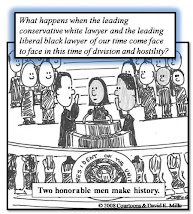
The Alcee Hastings Factor
Dividing 5-4, the Supreme Court ruled on Monday that federal voting rights law does not require the creation of a new legislative district when that would include a racial minority group that has less than 50 percent of the population, as a remedy when minority voters’ rights have been diluted. Only when a group of minority voters would form a majority in a single-member district must it be created as a remedy under Section 2 of the Voting Rights Act of 1965, the Court ruled in Bartlett v. Strickland (07-689).
Dividing 5-4, the Supreme Court ruled on Monday that federal voting rights law does not require the creation of a new legislative district when that would include a racial minority group that has less than 50 percent of the population, as a remedy when minority voters’ rights have been diluted. Only when a group of minority voters would form a majority in a single-member district must it be created as a remedy under Section 2 of the Voting Rights Act of 1965, the Court ruled in Bartlett v. Strickland (07-689).
How many times did Alcee and other African Americans run unsuccessfully for city and county commissions until single member districts favoring minorities became a reality? Ask Harvey Milk!
The Howard Finkelstein Factor
** By a 7-2 vote, the Court ruled that a state is not responsible for the delays in getting a criminal case to a trial, if those delays are the result of tactics or omissions by public defender lawyers. Just because a court-appointed lawyer is from a public defender’s office, the Court said, does not make those attorneys government actors, as such, for whom the state is responsible for their tactical choices. Assigned counsel’s blame for delays are to be attributed to the defense, not the state — unless there is a complete breakdown in the public defender system, the Court decided in Vermont v. Brillon (08-88). Justice Ruth Bader Ginsburg wrote for the Court.
Note the words ' a complete breakdown in the public defender system.' Isn't that almost what we have been hearing is on the verge of happening in Dade, Broward, and around the country?
The Credit Card Consumer Factor
** Over four partial dissenting votes, the Court ruled that a firm seeking to compel arbitration of a dispute may take the case to a federal District Court only if the underlying controversy could have been litigated in federal court. A federal court has no jurisdiction, Justice Ginsburg wrote for the Court, to order arbitration of “a slice of a controversy when the controversy as a whole” would be beyond its reach. The ruling came in a dispute over a claimed failure of a consumer to pay a credit card balance (Vaden v. Discover Bank, 07-773).
Who has a credit card anymore? It's now a debt card with no credit.
The Traffic Court Subpoena Factor
** Ruling unanimously, the Court decided that the $40 per day fee for witnesses in regular federal court proceedings also applies when witnesses are summoned to appear in a case under the Court’s Original jurisdiction. The ruling, written by Justice Alito, rejected a challenge by the state of Kansas to a special master’s fee decision in a long-running dispute with Colorado over water rights in the Arkansas River. (The case is Kansas v. Colorado, 105 Original.)
How crazy is it that we subpoena witnesses to court and give them $6.50 for being there when the county charges $8.00 for parking and you have to wait an hour to get in the damn building?







 Posts
Posts