Recent Broward Law Blog Features

Showing posts with label Right to Counsel. Show all posts

Monday, March 23, 2009

On Gideon's Anniversary, Court Appointed Federal Lawyers Get a Raise


Let's begin Monday by acknowledging a few intriguing notes.


Friday, I believe, was the 46th anniversary of Gideon v. Wainwright, the Supreme Court's 1963 decision holding that states have a constitutional obligation to provide court-appointed lawyers for indigent criminal defendants. Charged with breaking and entering into a Panama City, Florida, pool hall, Clarence Earl Gideon Gideon, was denied his request that an attorney be appointed to represent him. The Supreme Court reversed his conviction, holding that defense counsel is "fundamental and essential" to a fair trial.


"In our adversary system of criminal justice, any person haled into court, who is too poor to hire a lawyer, cannot be assured a fair trial unless counsel is provided for him," Justice Hugo L. Black wrote for the court. "This seems to us to be an obvious truth."


Gideon spawned systems for court appointment of criminal defense lawyers in every state and in the federal courts. But those systems are not without problems. At the state level, ensuring adequate funding is an ongoing battle. And for the lawyers who take court-appointed cases, ensuring adequate compensation is a whole other battle. Hourly rates paid to court-appointed lawyers remain well below private-market rates.

That said, private lawyers who take court-appointed cases in the federal system just got a pay raise. Last week, James C. Duff, director of the Administrative Office of the United States Courts, issued a memorandum directing the federal courts to increase the hourly rates and case maximums.


As of March 11, blogger Robert Ambrogi reports, the hourly rate for non-capital cases went from $100 to $110. For capital cases, the hourly rate went from $170 to $175. The maximum that a lawyer can bill for a case went from $7,800 for a felony trial to $8,600 and from $2,200 for a misdemeanor trial to $2,400. The maximum for a felony appeal is now $6,100, up from $5,600, and for a misdemeanor appeal $6,100, up from $5,600. The federal Office of Defender Services has detailed information about the new rates and maximums.

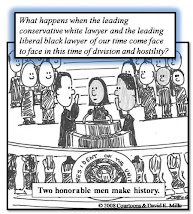
Here's the case that made history:

Thursday, February 5, 2009

Private Practice for Porn Dogs Senate Nominee Ogden


Members of the Senate Judiciary Committee pressed Deputy Attorney General nominee David Ogden today to distance himself from the views of those he represented in private practice, reviving a debate over how much senators should weigh a nominee’s choice of clients.

The issue is especially prominent for Ogden because he has often represented controversial clients in high-profile appellate cases. The American Family Association and anti-pornography activists have sent out e mail blasts urging their supporters to telegraph their senators they are vigorously opposed to Ogden’s selection. Meanwhile, in New Orleans, members of the First Amendment Lawyers’ Association are holding their annual meeting and celebrating his selection.

One of the key questions from Senator Orrin Hatch of Utah dealt with Ogden’s opposition to federal record keeping requirements regarding pornographic images. Hatch pointedly asked Ogden “How can we believe that the Justice Department will enforce this law and defend its constitutionality when you have argued for 20 years that it’s unconstitutional?”

It is worth sharing Ogden’s answer. “A lawyer in private practice does not sit in judgment on his clients. His job is to present their view as persuasively as possible,” he said. The most common question a criminal lawyer is asked is ‘how can you represent that person?’; how can you represent a guilty person.

I think you have to stand your ground and remind your inquisitors that as you meet your client the first time, he is not guilty and presumed innocent. You point out that within an adversary system each side gets to make a fair presentation of their case, and what you promise your client is effective advocacy.

More than anyone, United States senators should know that best. The inquiries were almost inappropriate coming from their chairs. I have said it before and I will say it again. Just because you represent someone accused of indecent exposure does not mean you leave your law office and go to Annie Beck Park wearing nothing but a raincoat. You simply provide for your client the defense your biggest critic would want for his own child if that kid were charged.

The Judiciary Committee has not set a date to vote on Ogden’s nomination, but I will be anxious to see how many on both sides of the aisle fail to support Ogden because of whom he once represented. It will only embarrass them and reflect their failure to grasp an understanding of the very system they are supposed to represent.

Sunday, February 1, 2009

Gideon's Ghost: Inmate Without Lawyer Sues Public Defender


Client Without Lawyer Sues Georgia Public Defender

By Norm Kent

Over the past year, we have seen the financial consequences of an overtaxed state criminal justice system face situations that are unparalleled in American history.

The issue has been as simple as cutbacks in pay, and furloughs for paid employees in both the State Attorney’s office as well as the Public Defender. Still, the most shocking announcements have come when public defenders announced they may refuse court appointments to represent indigent clients. These are bold and gutsy moves.

In Miami-Dade County, the former Public Defender, Bennett Brummer, filed suit to claim that right, arguing that his office is too overcrowded to provide effective representation for more clients. Broward’s Public Defender, Howard Finkelstein, has gone to court and effectively argued that it is not his constitutional duty to provide a public defender for individuals arrested on municipal ordinance violations by the various cities with the county.
Both men are not trying to deny services to clients. Each has a goal of insuring that the quality of services delivered will meet the corresponding and demanding need. Each is making an effective legal point that the state or local government has a duty to provide the resources necessary for their offices to provide a quality defense. Each points out they will have to make better judgements on who should be charged and prosecuted.

Similar issues have been raised with the Office of the Capital Collateral Counsel and the Conflict Counsel. Honorable people are concerned whether effective representation on complex cases can ever again be provided by a system straining at its loins. The issue is exploding in legal communities from South Florida to San Diego. The budget crisis is omnipresent. But what about the clients themselves? What do they do if they have no lawyer to represent them, though they have a constitutional right to one?

Fast forward then to Georgia, where an inmate, accused of murder, has just unearthed some new ground on the same argument. In Atlanta, a man charged with killing a woman has been without an attorney for eight months, and he has now filed a suit against the state’s public defender system, claiming it has failed him.

The lawsuit on behalf of Jamie Ryan Weis underscores budget problems at the Georgia Public Defender Standards Council. Two private attorneys assigned to represent Weis were removed because the council didn’t have the money to pay them, and two public defenders objected because they said they had heavy case loads and not enough resources. They withdrew, but though they were ordered back on the case, but nothing has happened.

The suit states that Prosecutors are seeking the death penalty for Weis, who is charged in a 2006 slaying. The prosecutors say they are ready to go, as soon as the guy has counsel.

The lawyers filing on his behalf are amongst the most prominent in the Atlanta legal community. The suit, not an understatement, reads that “this is surely an unprecedented deprivation of counsel in modern time.” Gideon's Ghost.

This state, our community, needs a global answer to a cosmic crisis that is not getting better, but only getting worse. Start with a criminal justice commission which looks at where we are, where we are going, and where we have been. Maybe those answers will make us realize our litigious and 'modern' society is overincarcerating our own people.

What is certain is the answers go beyond the exigencies of the moment. We need to look past the next case, the extra courtroom, and the backed up dockets. We need permanent solutions and not temporary fixes, or we continue to drown in the sewage of a flood we created. And in Broward County, with a structure that is erupting, that is not just an allegorical metaphor.

Thursday, January 29, 2009

'Guilty Until Proven Innocent'


Lord Polonius, speaking in Shakespeare's Hamlet, once opined that 'brevity is the soul of wit.' Sometimes, therefore, I just shut up and argue that 'silence is the heart of genius.'

We have all been watching the tv tour of the Illinois Governor, Rod Whateverovich. He's being impeached in Illinois while doing five minute spots with Whoopie Goldberg on 'The View'. He's been tarred and feathered by his own words and deeds.

As an attorney, you stare in disbelief. You say 'Only in America.' You think this guy must be a fool. You are so astonished by his seeming cognitive dissonance, you forget how this case was played out by the prosecutor, how unlevel he made the playing field from day one. You forget until you read this incredibly incisive blog by one of the nation's leading attorneys, Gerry Spence, reminding you that everyone is entitled to a fair trial in a courtroom. It's a bitch slap to the face of complaceny. You read this piece, and you say, 'Damn, I should have said that.' You then kick yourself, and again realize that no matter how old you are, there is much you can still learn.

So you just shut up, and let the smarter guy do the talking. Here then, is a sentry call from a great advocate, to every attorney who cares about justice, fairness, and due process. Read what Gerry Spence has to say:

Tuesday, January 27, 2009

Feces Facial Flips SD Public Defender


This from the ABA journal late Tuesday afternoon....


A defendant who wanted his public defender removed from the case will get his wish after smearing feces on his lawyer’s face and flinging the material at jurors.

Weusi McGowan was on trial in San Diego for a home invasion and robbery when he brought in a baggie filled with excrement during a mid-morning break, City Wire reports in a story posted on SanDiego6.com.
McGowan smeared the feces on the face and in the hair of Deputy Alternate Public Defender Jeffrey Martin, then flung the material toward the jurors, the story says.

The excrement missed Juror No. 9 but hit his briefcase.

Judge Jeffrey Fraser had denied McGowan’s request to represent himself, the story says. The judge declared a mistrial and said McGowan would have to get a new lawyer. In related news, Howard Finkelstein announced he is taking the day off tomorrow.
So where was the courthouse security when the guy came through the metal detector? I am just thinking how does this make it through, you feel me?

Monday, January 26, 2009

Local Attorneys Indicted in Alleged Fraud

Ripples of dismay and disbelief have permeated the courthouse since the revelations about federal charges against Broward attorneys Anthony Livoti, Jr., and Michael McNerney surfaced in the Miami Herald a few months ago.
They came to fruition with an indictment earlier this month. Both are respected and forceful advocates with sterling reputations. The story has gone national, with a lengthy Daily Business Review feature being picked up today by Law.Com. You can read the full story at this link-

We can only hope the Feds got this one wrong and both attorneys prevail in their defense that they were lawfully carrying out their fiduciary duties as counsel for the indicted corporate executives. On the heels of the sketchy case against Ben Kuehne in Miami, there are lots of questions raised in this one. In fact, a New York court last week just ruled that is inappropriate to go after attorneys for advice they delivered while acting in a legal capacity. You can access that case here:http://www.law.com/jsp/article.jsp?id=1202427548151
Prosecutions this close to the edge are an assault upon the adversarial system of justice. For a long time, since Ronald Reagan, the feds have thought that too many defense lawyers are 'on the side' of defendants and have sought to compromise their obligations. We are not 'on the side' of defendants; we are within the parameters of a justice system that has two sides, and each has a right to effective advocacy.